



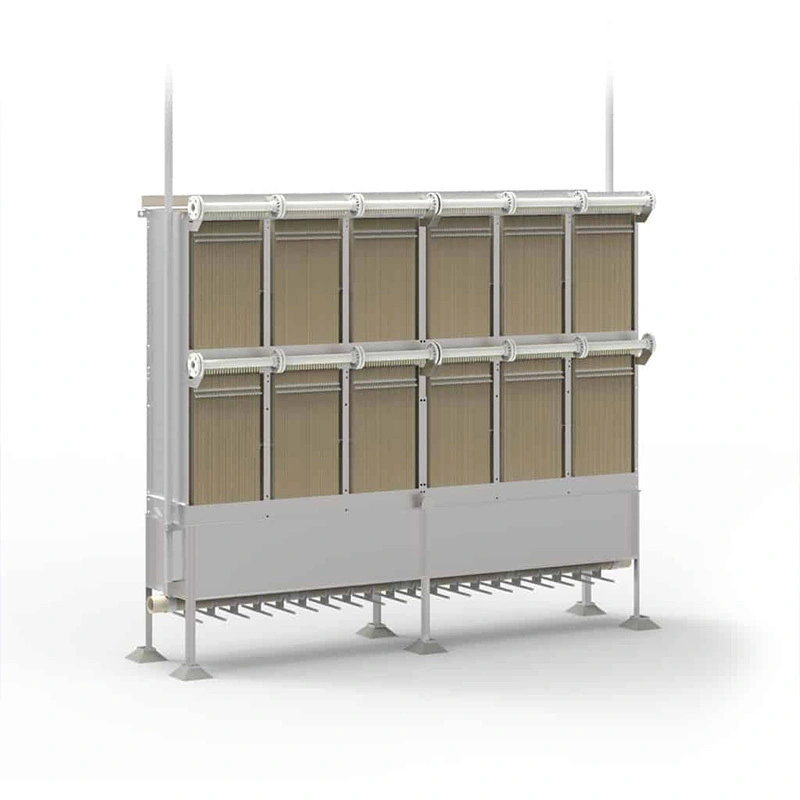
DEM140 (Replaces TORAY Toray TMR140 series flat membrane (MBR))
● Highly resistant to contamination: Compared to hollow fiber membranes, flat plate membranes have superior contamination resistance.
● Simpler system configuration and operation: Flat plate membranes operate stably for long periods of time without the need for a backwash system.
● Easy Maintenance: Flat membranes are designed for easy maintenance and cost savings.
| Membrane Element Specifications | ||
| Membrane Element Model | 50150 | |
| Membrane configuration | Flat sheet | |
| Application | Filtration of activated sludge | |
| Filtration method | Suction filtration | |
| Nominal pore diameter (um) | 0.08 | |
| Effective membrane area (㎡) | 1.4 | |
| Dimensions (mm) | Total width (mm) | 515 |
| Total height (mm) | 1608 | |
| Thickness (mm) | 13.5 | |
| Main material | Membrane (mm) | PVDF and PET non-woven fiber |
| Supporting panel (mm) | ABS resin | |
Monolithic Membrane Element Parameters
Technical Parameters
| MBR | ||||||
| DEM140-50S | DEM140-100S | DEM140-200W | DEM140-200D | DEM140-400W | ||
| Design flow rate (m³/d) |
8-53 | 15-105 | 30-210 | 30-210 | 60-420 | |
| Number of membrane elements (pcs) | 50 | 100 | 200 | 200 | 400 | |
| Total membrane area (㎡) | 70 | 140 | 280 | 280 | 560 | |
| Membrane Module Size | width (mm) | 810 | 810 | 840 | 810 | 840 |
| length (mm) | 950 | 1620 | 3260 | 1620 | 3260 | |
| height (mm) | 2100 | 2100 | 2100 | 4160 | 4160 | |
| Weight (kg) | Dry | 400 | 695 | 11430 | 1365 | 2690 |
| Materials | Frameworks | SUS316 | SUS316 | SUS316 | SUS316 | SUS316 |
| Produced water collection master tank | SUS316 | polypropylene | ||||
| Aeration pipe | ||||||
| Membrane Element Retaining Gasket | EPDM rubber | |||||
| Connecting flange | Produced water collection master tank | ANSI 1 ½ inch | ANSI 2 inch | ANSI 3 inch | ANSI 2 inch | ANSI 3 inch |
| Aeration pipe | ANSI 1 ¼ inch | ANSI 1 ½ inch | ANSI 2 inch | ANSI 1 ½ inch | ANSI 2 inch | |
| Operating range | Temp | 5-40℃ | ||||
| FluidsPH | 5-10 | |||||
| MLSS | not higher than18000mg/l | |||||
| Transmembrane pressure | not higher than 20KPa(200mbar) | |||||
Application Areas
•Large-scale wastewater projects
•Organic wastewater treatment;
•Old sewage plant process improvement;
•Surface water purification treatment;
•Reverse osmosis system influent pre-treatment;
•Restaurant or landscape wastewater treatment and reuse;
•Car wash plant ship sewage recycling and reuse;
•Various types of beverage factories, distilleries, food factories, livestock factories, slaughterhouses, dyeing and finishing plants, leather factories, pulp mills;
•Wastewater treatment for pharmaceutical factories and high concentration organic treatment plants;
•Large municipal wastewater treatment and reuse, community living water reuse, department stores, office building water reuse, sewage water reuse
How to install DEM140-Flat film
• Prepare equipment for unloading membrane modules from the truck (e.g., forklift, crane, trailer).
• Ensure all construction work inside the reactor tank is completed and the area is cleaned. Remove any large debris (e.g., concrete blocks, metal chips, residual materials) that may remain in the tank.
• During shipping, the membrane element section and the aeration unit are bundled separately.
• When lifting DEM flat-sheet ultrafiltration membrane elements, fully secure hooks to the lifting rings and maintain a horizontal lift. Avoid damaging the membrane's flow guide tubes and aeration pipes, and ensure operational safety throughout the process.
Precautions for use
Unpacking and Installation
● When lifting the membrane module, the hook or chain should be lifted smoothly to prevent the membrane module from shaking. It is strictly prohibited for any personnel to be located under the membrane module.
● When lifting the membrane module shell, use a hook or chain that matches the weight of the membrane module.
● When installing the membrane module, scaffolding should be prepared. Climbing on the shell is absolutely not allowed. Use the necessary protective equipment to ensure the safety of construction personnel.
● In the storage, transportation and use of membrane modules, you need to take the necessary measures to prevent damage to the membrane components, such as prohibited to place heavy objects on top of the membrane modules, as well as to prevent the membrane components and other items collision.
● Avoid placing the membrane module for a long period of time in a temperature environment of 40℃ or higher or in a place under direct sunlight. In particular, the ABS support plate can be damaged by direct sunlight or ultraviolet rays.
● During the whole process from installation to operation, it is strictly prohibited to contact the membrane module with sparks generated by welding, fusing, shearing or grinding.
● Prevent the membrane module from freezing.
● Avoid applying pressure at the water production end.
● In order to protect the membrane and prevent clogging, use a screen of 3mm or less to pre-treat the raw water for the membrane bioreactor.
Operation and Maintenance
● Do not drink the permeate water.
● When discharging or recycling the treated water, analyze the treated water according to the purpose of use and make sure that it meets the requirements for use.
● Hydrogen fluoride (HF) gas occurs when the membrane element is burned after use. When the membrane element is discarded, it must be disposed of by a professionally qualified disposal company.
● Open the air vent valve before adding fresh water to the reaction tank to exhaust the air inside the membrane element. Close the air vent valve after feeding water.
● It is recommended that surface water not be used in place of fresh water for operation, as surface water may cause membrane clogging if it contains large amounts of iron, manganese, calcium, and silica.
● Do not perform excessive clear water testing, as clear water operation may result in membrane clogging.
● Keep the membrane moist after water operation. Drying of the membrane may result in a decrease in water permeability.
● Do not filter without proper aeration, as this may result in clogging of the membrane surface.
● Chemicals, drugs, oils, or other substances that adversely affect activated sludge must not be added to the reaction tank.
● The ABS support plate will be chemically cracked when it comes in contact with some organic solvents, such as alcohol, oil or synthetic detergents. Therefore, contact of the ABS support plate with these substances should be avoided.
● Even within the operating conditions of the membrane module, try to avoid sudden changes in parameters such as temperature, pH, and differential membrane pressure.
● Regularly inspect and replace parts that need to be renewed.
● When removing the membrane module for maintenance, it is necessary to keep the membrane in a moist state at all times. Drying of the membrane may result in a decrease in water permeability.
● When stopping the filtration operation, stop aeration flushing of the membrane. However, it is not necessary to stop aeration during the normal intermittent operation phase of membrane filtration.
Chemical Cleaning of Membrane Elements
● The chemicals used for cleaning may contain substances that may cause harm if they come into contact with the human body. When using chemicals, be sure to wear protective equipment such as eyeglasses and gloves with extreme caution. Be sure to check the contents of the MSDS.
● If the chemical comes into contact with skin or clothing, rinse immediately with plenty of water.
● If the chemical gets into your eyes, immediately flush with plenty of water and seek medical attention.
● When performing chemical cleaning, stop the cleaning operation as soon as you notice any abnormalities.
● Do not use a dosing pump to inject chemicals directly into the membrane element, as this may cause damage to the membrane element due to internal pressure rise. The agent must be injected by gravity or at a pressure of 10kPa or less.
● When using a dosing pump, make sure that the membrane module is completely submerged in water and that the distance between the liquid level and the top of the membrane module is more than 500mm.
● Chemicals should be kept in a cool place, avoiding direct sunlight.
● In order to avoid corrosion, please choose storage tanks made of appropriate materials to hold the chemicals according to the nature of different chemicals.
● Sodium hypochlorite should not be mixed with heavy metals or acids. Please pay special attention to the fact that when it is mixed with acid, toxic chlorine gas will be produced.
● Do not mix oxalic or citric acid with sodium hypochlorite. They produce toxic chlorine gas when mixed.
● Please stop aeration flushing during chemical cleaning, otherwise the membrane element may be damaged.
Product scenario
Related products
+86-18019736003